

Losing a tooth changes more than your smile; it shifts how you chew, how you speak, and how you carry yourself throughout the day. If you’re weighing your options for replacing a missing tooth, you’ve likely come across two front-runners: dental implants and dental bridges. Both can restore function and appearance, but they work very differently and best serve different patients.
At Reed Dental Care in Yukon, Oklahoma, our restorative solutions are designed to meet you where you are, whether that’s prioritizing longevity, preserving existing teeth, or working within your current timeline. Dr. William Reed brings over 15 years of experience helping patients make confident, informed decisions about their care, and this comparison is one he regularly walks patients through.
What Is a Dental Bridge?
A dental bridge is a fixed restoration that spans the gap left by a missing tooth. It works by anchoring an artificial tooth (called a pontic) to the natural teeth on either side of the space, which are permanently modified to support the bridge.
How Bridges Work
To place a bridge, the two teeth on either side of the gap (also known as abutment teeth) must be shaped down to accommodate crowns. Those crowns then support the pontic in the middle. Once cemented, a bridge is not removable and functions like a fixed part of your mouth.
What to Consider With a Bridge
Bridges can be a strong option when the adjacent teeth already need crowns or have large restorations. They also tend to have a faster treatment timeline, since they typically don’t require a healing period. However, permanently reshaping healthy adjacent teeth is a real trade-off, and a bridge does not address the bone loss in the jaw that occurs after a tooth is lost.
What Is a Dental Implant?
A dental implant is a titanium post surgically placed into the bone, where it fuses with the bone through a process called osseointegration. Once healed, a crown is attached on top, creating a restoration that closely mimics a natural tooth from root to tip.
How Implants Work
The implant itself acts as an artificial tooth root. Over the course of several months, it bonds with the surrounding bone, creating a stable foundation. Because it’s anchored in the jaw, it stimulates the bone similarly to the way a natural tooth root would, which helps prevent the bone loss that commonly follows tooth extraction.
Longevity Worth Noting
Research published by the National Institutes of Health found that dental implant survival rates after 20 years ranged from roughly 80% to 92% depending on the patient cohort and study design. That’s a durability profile that few restorations can match.
Key Differences Between the Two
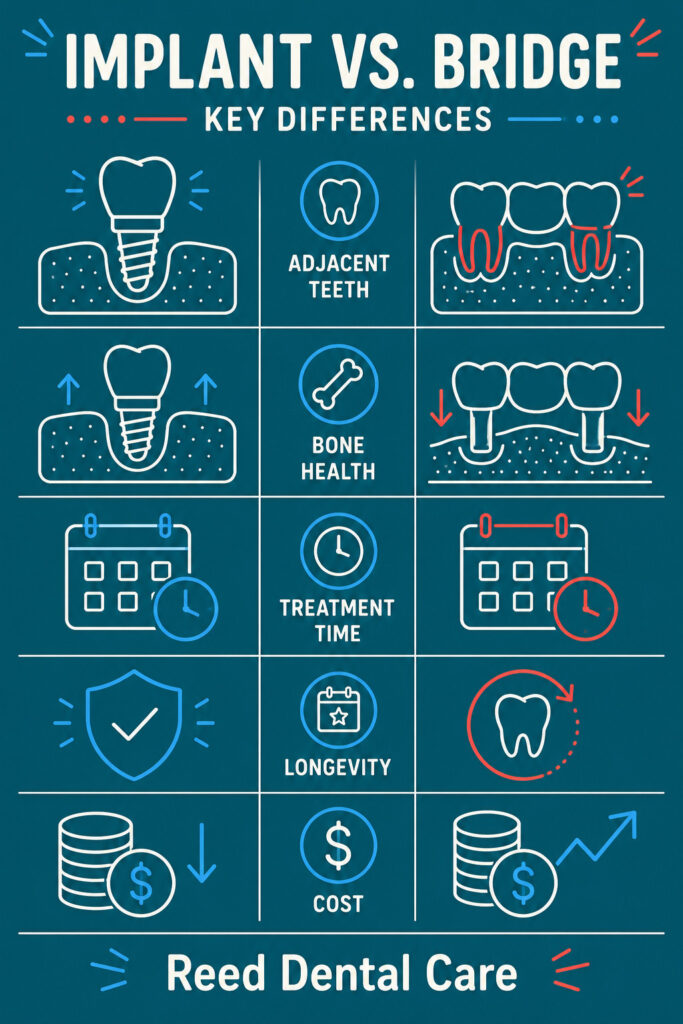
Choosing between an implant and a bridge comes down to several personal factors. Here is a quick breakdown of how they compare:
- Adjacent teeth: Bridges require modifying the teeth next to the gap; implants stand alone and leave neighboring teeth untouched.
- Bone health: Implants preserve bone by stimulating it; bridges do not address bone loss.
- Treatment time: Bridges can often be completed in a few weeks; implants typically require several months for osseointegration.
- Longevity: Implants tend to last longer with proper care; bridges may need replacement after 7-10 years.
- Cost: Bridges generally have a lower upfront cost, though implants may be more economical over time.
Both options can produce excellent cosmetic results, and the right choice depends on your bone health, overall oral health, and personal priorities.
When One Option May Be Better Than the Other
There is no universal answer here, and that’s exactly why a consultation matters. Implants tend to be the stronger long-term investment for patients with adequate bone density and no significant medical contraindications. They work especially well when the adjacent teeth are healthy and don’t need to be altered.
Bridges may be the preferred route when bone loss has already progressed significantly, when a patient needs a faster solution, or when implant surgery isn’t medically advisable. Dr. Reed uses advanced dental technology (including 3D cone-beam imaging) to assess your bone structure and determine which option will provide the best outcome for your specific situation. This kind of detailed diagnostic imaging removes the guesswork and grounds every recommendation in real data.
Frequently Asked Questions About Dental Implants and Bridges
How do I know whether an implant or a bridge is the better option for me?
The right choice depends on factors like your jaw bone density, the condition of the teeth next to the gap, your timeline, and your budget. A dental exam with imaging, such as 3D cone-beam scans, gives a clear picture of your bone structure and helps determine which restoration will hold up best for your specific situation.
Is a dental implant more painful than getting a bridge?
Both procedures are performed with local anesthesia, so patients typically report only mild discomfort afterward that is managed with over-the-counter pain relief. Implant placement involves a short surgical step followed by a healing period, while a bridge involves reshaping the adjacent teeth, which some patients find more sensitive in the days after the appointment.
How long does the entire process take for each option?
A bridge can often be completed in just a few appointments over a few weeks since it does not require a healing period. An implant takes longer overall, typically several months, because the post needs time to fuse with the jaw bone through osseointegration before the final crown is placed.
Does dental insurance typically help cover implants or bridges?
Coverage varies widely by plan and provider. Many dental insurance policies cover a portion of bridge treatment, since bridges have been a standard restoration for decades, while implant coverage has become more common but still differs from plan to plan. Your dental office can help verify your specific benefits before treatment begins.
Can I switch from a bridge to an implant later on?
In many cases, yes. If a bridge eventually needs replacement, an implant can sometimes be placed at that point, provided there is enough healthy bone remaining. This is one of several reasons it is worth discussing long-term goals with your dentist even if you start with a bridge now.
Schedule Your Consultation at Reed Dental Care
Dr. Reed and the team at Reed Dental Care take pride in offering restorative solutions that are grounded in both clinical evidence and a genuine understanding of each patient’s life and goals. With over 15 years of experience, Dr. Reed has helped hundreds of patients in the Yukon and Mustang areas navigate exactly this kind of decision with honesty, patience, and no pressure.
Whether you’re a strong candidate for implants or a bridge makes more sense for your situation, the first step is simply having a conversation. Reach out through our contact page to schedule your consultation, and we’ll help you move forward with clarity.