

Your tooth has been giving you trouble for weeks. A dull ache, some sensitivity when you bite down, maybe a crack you have been trying to ignore. At some point, the question shifts from “should I call the dentist?” to “is this bad enough for a crown?” It is a fair question, and the answer depends on what is actually happening inside that tooth.
At Reed Dental Care, Dr. Reed brings more than 15 years of clinical experience to restorative dentistry, including same-day CEREC crown technology that mills a permanent ceramic crown chairside in a single visit. Understanding when a crown is the right call and when it is not starts with knowing what a crown is actually designed to protect.
What a Crown Does That a Filling Cannot
A filling patches a small-to-moderate cavity. A crown covers the entire visible portion of a tooth, providing structural protection when decay, damage, or wear has compromised the natural tooth to the point that it cannot be reliably restored any other way. The National Institute of Dental and Craniofacial Research notes that crowns are used to repair badly broken-down teeth when a filling alone is no longer a reasonable option.
The distinction matters because placing a filling on a tooth that actually needs a crown is a short-term fix. The remaining tooth structure continues to bear stress it was never meant to handle, which often leads to a fracture or secondary decay that is more complicated to treat than the original problem.
Tooth Decay That Goes Beyond the Surface
When decay reaches the inner layer of a tooth, it removes the solid foundation that a filling depends on. A filling bonds to healthy tooth structure, so if more than roughly half of the tooth has been destroyed by decay, there is not enough surface area left for the filling to stay in place under normal bite pressure. At that point, a crown becomes the correct treatment, not an upgrade. Patients who keep up with preventative care appointments give Dr. Reed the best chance of catching decay at a stage where it can still be addressed with a filling.
A Fractured or Cracked Tooth
Cracks vary considerably in how serious they are. A surface-level craze line is cosmetic and does not require treatment. A crack that extends down through the cusp or toward the root puts the tooth at risk of splitting, which typically leads to extraction. A crown holds the tooth together and keeps the crack from widening further under chewing pressure. This is one of the scenarios where time genuinely matters, because a crack that is manageable today can become a fracture that is not.
After a Root Canal
Root canal treatment removes the pulp and blood vessels from inside the tooth. Without it, the tooth no longer receives hydration and becomes more brittle over time. Most back teeth, and many front teeth, require a crown after a root canal to help prevent them from fracturing under normal bite force. At Reed Dental Care, the CEREC same-day crown technology allows Dr. Reed to complete the crown in the same appointment as the root canal follow-up, rather than sending patients home with a temporary for several weeks.
Signs During a Dental Exam That a Crown May Be Needed
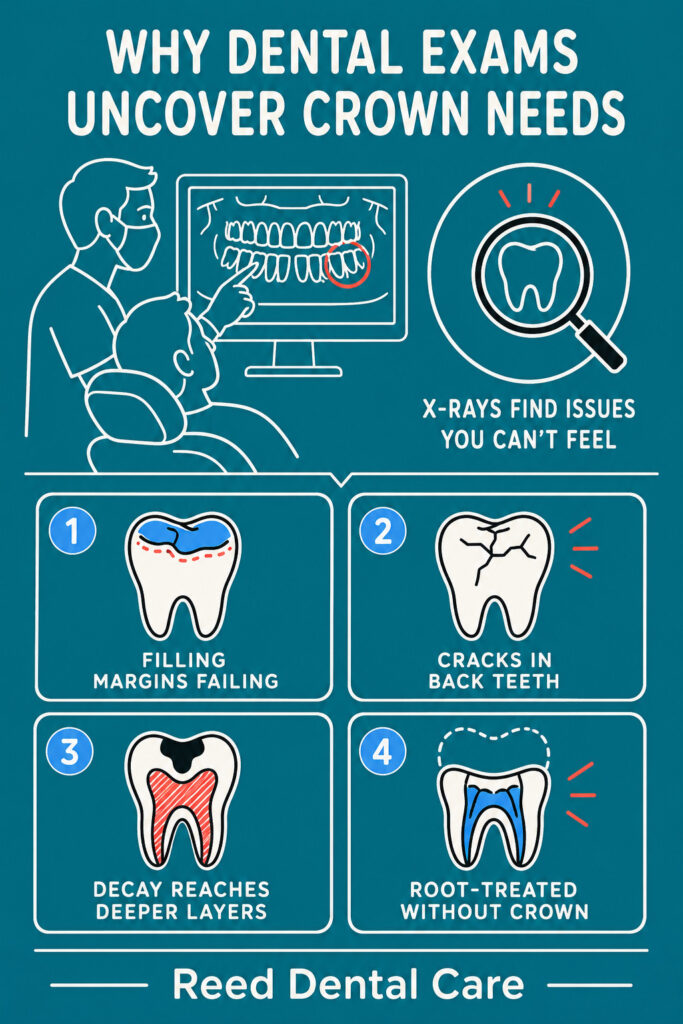
Patients sometimes assume they will feel it when a tooth needs a crown. The reality is that the most telling signs show up on X-rays and during an exam, not necessarily in day-to-day discomfort. During a thorough checkup, Dr. Reed reviews current X-rays and checks for the following:
- Large existing fillings that are beginning to fail at the edges, also called margins
- Visible fracture lines under magnification on posterior teeth
- Decay that has reached the tooth’s dentin or deeper
- Teeth that have undergone root canal treatment and are still uncrowned
Any of these findings warrants a conversation about whether a crown is the appropriate next step. Not every case results in one, but identifying these conditions early gives patients more options than waiting until the tooth breaks.
What Same-Day CEREC Technology Changes
The traditional crown process involves two appointments, a temporary crown between them, and a wait of one to three weeks for a lab to fabricate the permanent restoration. Dr. Reed uses CEREC technology, which designs and mills the crown chairside from a ceramic block in the same appointment. Patients leave with the final crown seated that day.
This matters in practice for people who have been putting off a crown appointment because of the time involved or the discomfort of wearing a temporary crown. Same-day CEREC crowns at Reed Dental Care fit within a standard appointment window, and the ceramic material is color-matched to the existing tooth during the visit. For patients coming in for a general exam who are flagged for a crown, the CEREC system often means they do not need to schedule a second trip.
Schedule Your Appointment at Reed Dental Care
Dr. Reed graduated from the University of Oklahoma College of Dentistry in 2010 and spent over a decade providing care to the Kickapoo Tribe of Oklahoma before taking ownership of Reed Dental Care in Yukon. Patients who are concerned about a specific tooth, have an older filling they know is getting large, or have simply been putting off a dental exam, are encouraged to come in for a current look.
Reed Dental Care is in-network with HealthChoice and Delta Dental Premier, and CareCredit as well as Cherry financing is available. To schedule an appointment, contact our office using the online form.